Remarks of Lawrence E. Strickling, U.S. Assistant Secretary of Commerce for Communications and Information, at IGF2015, the Internet Governance Forum 2015, at João Pessoa, Brazil, on November 10, 2015–as prepared for delivery–(emphasis added):
Thank you. At the outset, let me congratulate our host nation, Brazil, as the first country to have hosted two meetings of the Internet Governance Forum (IGF). It is fitting that Brazil, with its strong tradition of supporting multistakeholder Internet governance, be the first country to earn this honor.
Over the past 10 years, the IGF has proven itself to be an indispensable platform for addressing Internet issues. I look forward each year to attending the IGF and meeting with this diverse collection of stakeholders to tackle the challenges facing the Internet. This year I am pleased to see important innovations in the IGF’s intersessional work on items such as the best practices forums and the IGF policy options document on connecting the next billion. These and other innovations will enrich the conversations this week in Brazil.
As we mark the 10-year anniversaries of the World Summit on the Information Society (WSIS) and the IGF, it is important to take stock of where we have come and the challenges ahead. There is much to celebrate in how the Internet has evolved into a platform for global economic growth, innovation and free speech. The open Internet is helping the economies and societies of both developed and developing nations. Not only has it created a dynamic and growing digital economy, it has transformed just about every facet of our day-to-day lives. Every one of us has a stake in ensuring the continued growth, job formation and wealth creation that an open Internet brings.
In the United States, we attribute that success in large part to the bottom-up, multistakeholder approach to resolving technical and policy challenges facing the Internet. This is why we are such strong supporters of the IGF – one of the preeminent international examples of this approach – and have called for an extension of the IGF that is consistent with its original mandate. We are pleased that so many countries have echoed this call. If collectively, we continue to support multistakeholder Internet governance, if we make it more inclusive of developing countries and more responsive to all stakeholders, then we can truly achieve the Information Society we envisioned 10 years ago.
In the United States, we are committed to multistakeholder Internet governance, as convincingly demonstrated by our announcement in March 2014 that the U.S. government would transition its historical stewardship role over the Internet Domain Name System to the multistakeholder community. Since that time, the response from the community of technical experts, academics, civil society and industry has been inspiring. Over the past year and a half, stakeholders have worked hundreds of hours to complete a transition proposal that meets the criteria we have outlined. We are hopeful the working groups will complete their work in the coming weeks.
This work is tiring; sometimes contentious; perhaps exasperating. No doubt, this is not an easy task. But it is an important one. All of us should appreciate the effort and level of commitment demonstrated by all the participants in this process. Most importantly, the process is working and I am confident it will be successful. It will be a testament to the strength of the multistakeholder process when the transition is completed.
But even with the growth of international support for multistakeholder governance, there is continued cause for concern. Freedom House’s 2015 report on Internet freedom finds that Internet freedom around the world is in decline for a fifth consecutive year. More governments are censoring information from their citizens and attempting to put up barriers to the open Internet within their borders.
The growth of sophisticated malware and other cyber security threats, the need to protect the privacy of Internet users and the mounting online theft of intellectual property online have challenged governments’ ability to balance these important interests with the equally important need for openness. Governments increasingly feel compelled to do something they see as meaningful – if not outright drastic – to protect their citizens and their businesses from these threats.
Regrettably, in their attempts to do something to protect their citizens and businesses, governments sometimes rush to put up digital walls between their countries and the rest of the world, between their citizens and people abroad. In recent years, we have seen governments institute data localization laws, as well as impose limitations on data storage and data transfer.
Historically, these kinds of restrictive policies have tended to be pursued by authoritarian governments that want to try to control information and monitor the activities of their citizens. In recent years, however, even democratic countries have considered restrictions on data flows.
Such proposals do far more harm than good. Restricting data flows and competition between firms increase costs for Internet users and businesses, retard technological innovation, and may curb freedom of expression.
This assessment may seem like common sense to many of us in this room. But it is not accepted by everyone. And that is why it is imperative that we continue multistakeholder venues like the IGF. They allow us – as representatives of diverse stakeholder communities – to come together, to offer our unique perspectives, to work through our most difficult problems, and to make a case for policies and practices that encourage the development of an open and innovative Internet.
In closing, I urge all nations to step up in support of the free and open Internet and the multistakeholder process that has led to its success. If we want to maintain a vibrant and growing Internet, we must all take action to ensure that the multistakeholder approach continues to define the future of Internet governance. Thank you for listening.
Source: US Government - NTIA

Showing posts with label NTIA. Show all posts
Showing posts with label NTIA. Show all posts
17 August 2015
NTIA Notice, Request for Comments, IANA Stewardship Transition Proposal
Federal Register | Internet Assigned Numbers Authority Stewardship Transition Consolidated Proposal and Internet Corporation for Assigned Names and Numbers Accountability Enhancements; Request for Comments: A Notice by the National Telecommunications and Information Administration on 08/10/2015: (the following is an abbreviated form of the full notice which appears in the Federal Register at the link above)--
SUMMARY
This notice announces the dates of a comment period during which the public is invited to provide input on two interrelated multistakeholder community proposals. Together, the proposals set forth a plan for transitioning NTIA's stewardship role over the Internet Assigned Numbers Authority (IANA) functions. The purpose of this notice is to encourage interested parties to comment on the two connected proposals—the IANA Stewardship Transition Plan and the Enhancements to Internet Corporation for Assigned Names and Numbers (ICANN) Accountability Related to the IANA Stewardship Transition. NTIA will utilize the input provided in making its determination of whether the proposals have received broad community support and whether the plan satisfies the criteria required to transition its stewardship role.
DATES:
Comments on the IANA Stewardship Transition Plan are due on or before September 8, 2015; comments on the Enhancements to ICANN Accountability are due on or before September 12, 2015.
ADDRESSES:
Written comments on the IANA Stewardship Transition Proposal should be submitted at https://www.ianacg.org/calls-for-input/combined-proposal-public-comment-period/. Written comments on the proposed Enhancements to ICANN's Accountability should be submitted at https://www.icann.org/public-comments/ccwg-accountability-2015-08-03-en.
SUPPLEMENTARY INFORMATION:
Background
A July 1, 1997, Executive Memorandum directed the Secretary of Commerce to privatize the Internet's domain name system (DNS) in a manner that increases competition and facilitates international participation in its management. [1] To fulfill this Presidential Directive, the Department of Commerce issued a Statement of Policy on June 10, 1998, stating that the U.S. Government “is committed to a transition that will allow the private sector to take leadership for DNS management.” [2] On March 14, 2014, NTIA announced its intent to complete the privatization of the DNS. [3] In that announcement, NTIA called upon ICANN to convene a multistakeholder process to develop the transition plan. [4] While looking to stakeholders and those most directly served by the IANA functions to work through the technical details, NTIA established a clear framework to guide the discussion. Specifically, NTIA communicated to ICANN that the transition proposal must have broad community support and address the following four principles:
The ICG and CCWG are now seeking public comment on their respective recommendations. Comments provided will be used by NTIA to determine whether the proposals satisfy NTIA's criteria and have received broad community support. Comments will also be considered in any NTIA certification before the U.S. Congress that may be required prior to terminating the existing IANA functions contract currently in place between NTIA and ICANN. [8] To ensure that all views are taken into consideration, NTIA encourages interested parties—including U.S.-based stakeholders—to file written comments by the deadline.
Dated: August 4, 2015.
Angela Simpson,
Deputy Assistant Secretary, National Telecommunications and Information Administration.
FOOTNOTES
1. Memorandum on Electronic Commerce, 2 Pub. Papers 898 (July 1, 1997).
2. National Telecommunications and Information Administration,Management of Internet Names and Addresses, 63 FR 31741 (June 10, 1998),available at http://www.ntia.doc.gov/federal-register-notice/1998/statement-policy-management-internet-names-and-addresses.
3. See NTIA's authorities, 15 U.S.C. 1512; 47 U.S.C. 902(b)(2)(H).
4. NTIA Announces Intent to Transition Key Internet Domain Name Functions (Mar. 14, 2014) available at http://www.ntia.doc.gov/press-release/2014/ntia-announces-intent-transition-key-internet-domain-name-functions
5. A concurrent resolution expressing the sense of Congress regarding actions to preserve and advance the multistakeholder governance model under which the Internet has thrived, 112th Cong. 2nd sess. S.Con.Res.50 and H.Con.Res.127 (2012).
6. See IANA Stewardship Transition Coordination Group, available at https://www.ianacg.org/.
7. See CCWG on Enhancing ICANN Accountability, available at https://community.icann.org
8. DOTCOM Act of 2015, H.R. 805 and S. 1551, 114th Cong. (2015).
more news links below (on mobile go to web version link below)
Follow @expvccom
SUMMARY
This notice announces the dates of a comment period during which the public is invited to provide input on two interrelated multistakeholder community proposals. Together, the proposals set forth a plan for transitioning NTIA's stewardship role over the Internet Assigned Numbers Authority (IANA) functions. The purpose of this notice is to encourage interested parties to comment on the two connected proposals—the IANA Stewardship Transition Plan and the Enhancements to Internet Corporation for Assigned Names and Numbers (ICANN) Accountability Related to the IANA Stewardship Transition. NTIA will utilize the input provided in making its determination of whether the proposals have received broad community support and whether the plan satisfies the criteria required to transition its stewardship role.
DATES:
Comments on the IANA Stewardship Transition Plan are due on or before September 8, 2015; comments on the Enhancements to ICANN Accountability are due on or before September 12, 2015.
ADDRESSES:
Written comments on the IANA Stewardship Transition Proposal should be submitted at https://www.ianacg.org/calls-for-input/combined-proposal-public-comment-period/. Written comments on the proposed Enhancements to ICANN's Accountability should be submitted at https://www.icann.org/public-comments/ccwg-accountability-2015-08-03-en.
SUPPLEMENTARY INFORMATION:
Background
A July 1, 1997, Executive Memorandum directed the Secretary of Commerce to privatize the Internet's domain name system (DNS) in a manner that increases competition and facilitates international participation in its management. [1] To fulfill this Presidential Directive, the Department of Commerce issued a Statement of Policy on June 10, 1998, stating that the U.S. Government “is committed to a transition that will allow the private sector to take leadership for DNS management.” [2] On March 14, 2014, NTIA announced its intent to complete the privatization of the DNS. [3] In that announcement, NTIA called upon ICANN to convene a multistakeholder process to develop the transition plan. [4] While looking to stakeholders and those most directly served by the IANA functions to work through the technical details, NTIA established a clear framework to guide the discussion. Specifically, NTIA communicated to ICANN that the transition proposal must have broad community support and address the following four principles:
- Support and enhance the multistakeholder model;
- Maintain the security, stability, and resiliency of the Internet DNS;
- Meet the needs and expectation of the global customers and partners of the IANA services; and
- Maintain the openness of the Internet.
The ICG and CCWG are now seeking public comment on their respective recommendations. Comments provided will be used by NTIA to determine whether the proposals satisfy NTIA's criteria and have received broad community support. Comments will also be considered in any NTIA certification before the U.S. Congress that may be required prior to terminating the existing IANA functions contract currently in place between NTIA and ICANN. [8] To ensure that all views are taken into consideration, NTIA encourages interested parties—including U.S.-based stakeholders—to file written comments by the deadline.
Dated: August 4, 2015.
Angela Simpson,
Deputy Assistant Secretary, National Telecommunications and Information Administration.
FOOTNOTES
1. Memorandum on Electronic Commerce, 2 Pub. Papers 898 (July 1, 1997).
2. National Telecommunications and Information Administration,Management of Internet Names and Addresses, 63 FR 31741 (June 10, 1998),available at http://www.ntia.doc.gov/federal-register-notice/1998/statement-policy-management-internet-names-and-addresses.
3. See NTIA's authorities, 15 U.S.C. 1512; 47 U.S.C. 902(b)(2)(H).
4. NTIA Announces Intent to Transition Key Internet Domain Name Functions (Mar. 14, 2014) available at http://www.ntia.doc.gov/press-release/2014/ntia-announces-intent-transition-key-internet-domain-name-functions
5. A concurrent resolution expressing the sense of Congress regarding actions to preserve and advance the multistakeholder governance model under which the Internet has thrived, 112th Cong. 2nd sess. S.Con.Res.50 and H.Con.Res.127 (2012).
6. See IANA Stewardship Transition Coordination Group, available at https://www.ianacg.org/.
7. See CCWG on Enhancing ICANN Accountability, available at https://community.icann.org
8. DOTCOM Act of 2015, H.R. 805 and S. 1551, 114th Cong. (2015).
more news links below (on mobile go to web version link below)
Follow @expvccom

21 July 2015
NTIA Larry Strickling's Remarks at the Internet Governance Forum USA
Remarks of Assistant Secretary Strickling at the Internet Governance Forum USA 07/16/2015 | NTIA:
Remarks of Lawrence E. Strickling
Assistant Secretary of Commerce for Communications and Information
The Internet Governance Forum USA [IGF-USA]
Washington, D.C.
July 16, 2015—As Prepared for Delivery—
Thank you, Shane, for the introduction. I also want to thank the U.S. IGF Multistakeholder Advisory Planning Committee for planning this event and George Washington University for hosting. I have enjoyed having the opportunity to speak at each of these IGF-USA events since they started back in 2009.
When I look at your agenda for the day, much of it mirrors our agenda at NTIA. Rather than devoting my remarks to one specific issue, I will use my time this morning to take stock of the multistakeholder process as a tool for addressing the key issues that exist in the Internet policy space and to reaffirm our strong support for the model in the work we do.
An appropriate starting point for these remarks is the ongoing work of the global Internet community to develop the plan to transition NTIA’s stewardship role with respect to the Internet Domain Name System [DNS].
In a testament to the success of the multistakeholder model, technical experts and representatives of private industry, academia, civil society and governments are working around-the-clock to complete a transition proposal that meets the criteria we have outlined. This work is tiring; sometimes contentious; perhaps exasperating. No doubt, this is not an easy task. But it is an important one, and I greatly appreciate the effort and level of commitment demonstrated by all the participants in this process. Most importantly, it is working and I am confident it will be successful.
The effort is a compelling demonstration that bringing together all stakeholders, including businesses, technical experts, civil society and government, to resolve issues on a consensus basis is the best way to set the future direction of the Internet. Over the past 20 years, the Internet has flourished. It has driven economic growth, innovation and free expression around the globe. And a big part of its success can be attributed to this multistakeholder approach to resolving technical and policy challenges.
It is not hard to understand why this has been the case. Like the Internet itself, the multistakeholder model is characterized by its open participation and decentralized processes. The Internet thrives only through the cooperation of many different parties. The multistakeholder model reflects this fact by enabling a diversity of stakeholders to participate, fostering a diversity of opinions and ideas. The result is more creative problem solving. It is a nimble, flexible approach, much better suited to rapidly changing technologies, business practices, and markets than traditional regulatory or legislative models.
This is not to say that multistakeholder processes are easy. They can be chaotic and they do require a serious commitment of time and energy from participants. But they have a record of success. The Internet works seamlessly today because a cadre of technologists, policy wonks and others through such groups as the Internet Engineering Task Force (IETF) put their heads together to standardize voluntary programming languages, security protocols, and other web technologies.
Stakeholders continue to update these standards on an ongoing basis. If these technological challenges had been handed off to the typical Washington regulatory or legislative processes to resolve, we might still be waiting for a resolution. Worse, we might have technical protocols that are hopelessly out of date, hamstringing technologists and users from creating the robust, evolving Internet we enjoy today. One shudders to imagine an HTML standard drafted by a government committee.
And of course we have seen the model work in the context of ICANN, where the Internet community has come together to resolve technical and policy issues related to the Internet Domain Name System for nearly 17 years. This system ensures that users are able to easily access content by typing in simple names like www.doc.gov rather than confusing numeric addresses.
So we know this model can work. That’s why we continue to embrace it as the best tool to meet our mission at NTIA to preserve and protect the Internet as a platform for economic growth, innovation, and the free flow of information. This mission places us front and center at every major Internet policy debate today – privacy, Internet governance, cybersecurity and more. We are committed to making progress where we can to ensure that our digital economy continues to grow and thrive. But we cannot do it by ourselves. We need you to come to the table, roll up your sleeves and work with us to find solutions to these complex issues.
In the next several weeks, NTIA will be kicking off two new multistakeholder processes. The first will tackle issues related to privacy, transparency and accountability regarding unmanned aircraft systems (UAS). Our first meeting is scheduled for August 3.
The second new process will focus on cybersecurity vulnerability disclosures and will get underway in September. We will also be reconvening the facial recognition privacy multistakeholder process on July 28. In all three instances, we selected the topics after soliciting broad input from the community. In any multistakeholder process, the community must decide when a topic is ripe for discussion and possible consensus in order for it to be successful.
We are putting our time and resources in the multistakeholder process because we know it can help build trust in the digital ecosystem. For the sustainability and continued growth of the Internet, it is imperative that we preserve the trust of all actors on the Internet. The multistakeholder process has the ability to produce – in a timely way – meaningful guideposts for industry and consumers in this rapidly evolving technological environment. That cannot be said for the legislative or regulatory processes in Washington.
As we continue to engage the community in these multistakeholder efforts, we are constantly reassessing how we employ the process. We welcome the community’s ongoing feedback on how to improve our processes. That’s part of the beauty of the model – it’s adaptable and flexible in a way that regulatory approaches could never be.
We are particularly concerned about identifying and reducing the barriers to participation in these processes. For example, we have heard concerns about the time it takes to reach consensus. I grant you that reaching consensus on challenging policy issues does not happen overnight. In our first multistakeholder process on privacy, it took over one year to reach consensus on a code of conduct aimed at improving disclosures on mobile devices. But today, enhanced privacy notices based on the code are now live in apps used by 200 million consumers and the numbers are growing.
A one-year process to make substantial progress on a policy issue impacting millions of consumers – that’s lightning speed in Washington. Complex policy issues typically take years to make their way through the regulatory and legislative morass of Washington. Most efforts end in failure. The few that do reach a conclusion inevitably solve a problem that no longer exists or has been overtaken by newer issues that themselves need to be addressed.
Washington policymakers have struggled mightily to update laws impacting core technology policy issues – even when nearly everyone agrees updates are desperately needed. For example, the Electronic Communications Privacy Act (ECPA) was enacted in 1986 – almost 30 years ago. It governs a range of key issues regarding electronic communications, but it has not been significantly revised since its enactment. ECPA has created frustrations for law enforcement, judges and advocates for decades. All key stakeholders agree that the law should be updated to take account of developments -- like the development of powerful mobile devices, widespread email use, and cloud computing – that were unforeseen in the mid-80s and are handled clumsily by ECPA. Experts have called for Congress to amend ECPA to ensure the standard of protection for online, digital content is consistent with that afforded to data in the physical world. Proposal after proposal has been floated over the years. Despite the best of intentions, lawmakers have not been able to break the logjam and update a law that is sorely in need of revision.
So in evaluating the time it takes to reach consensus in a multistakeholder process, consider the alternatives. They are no faster.
Some stakeholders have also shared their concerns that multistakeholder processes are too resource-intensive. I understand that participants have to pick and choose their battles. Meetings can be lengthy. And some participants have spent countless hours working through drafts of documents. We want to encourage broad participation in the three multistakeholder efforts that will be proceeding on parallel tracks this summer. We suggest to those companies and organizations that find it hard to attend all of these events to find a way to pool resources with other like-minded organizations to lighten the load of direct participation.
But, as with the concern about the time the process takes, some of the concerns may simply reflect that it takes time to acclimate to this new style of dealing with policy issues. Our processes are still less burdensome than working through regulatory proceedings or preparing for litigation. Every important proceeding at the FCC attracts thousands of pages of comments, which then require hundreds of hours for participants to read and digest and prepare their own filings. But people are used to that process and perhaps do not question it the same way as they might a new and less familiar process.
So in evaluating the resources it takes to reach consensus in a multistakeholder process, consider the alternatives. They are no less burdensome.
Nonetheless, we want to improve our process. If the community feels our process takes too long and uses too many resources, perhaps we should ask ourselves, are we setting the bar too high for consensus agreement? At the outset of each process, we need a shared understanding of consensus. Should the stakeholder community consider whether “rough consensus” is good enough in some instances? When stakeholders reach a point of exhaustion – where they have come to a place that the output could be operationalized in the marketplace, and later improved upon – it could be time to press pause and move forward. Stakeholders in IETF often commit themselves to “rough consensus and running code” – there could be a lesson there for our stakeholder engagements. At the end of the day, we leave it up to the community to decide when the work is done and we look forward to your input on that issue as our multistakeholder work starts up or resumes this month.
The last aspect of the multistakeholder process I will address is also perhaps the toughest. For these efforts to succeed, we need players to come to the table with open minds, committed to collaborating fully in the process. Everyone needs to be committed to reaching a consensus outcome and be willing to compromise to achieve that goal.
The strategy of some participants in legislative and regulatory proceedings may be simply to preserve the status quo – that approach will not work in a multistakeholder process. Moreover, I suggest to you that a strategy of accepting the status quo as an outcome of the discussions on the Internet policy issues we face today is not a strategy for success for your company or organization.
Just as the Internet economy is constantly evolving and disrupting existing business models, our policy responses also need to evolve. We cannot leave issues untended – all that will do is slow down innovation on the Internet and perhaps leave our businesses at a disadvantage in the global marketplace. Alan Deutschman’s business adage, “Change or Die,” applies just as aptly to Internet policy debates as it does to companies trapped in business models that are rapidly becoming obsolete.
Where does this discussion leave us? We have to ask ourselves whether we are better off playing the legislative and regulatory waiting game where progress perhaps never occurs. Or are we better off taking up these issues in discussions where we might reach consensus on some critical issues? Are we better off with laws and regulations that are obsolete when they are passed, or even a patchwork quilt of state rules and regulations, leaving millions of consumers subject to different protections depending on where they reside? Or are we better off with a process that is flexible and allows businesses to adjust in response to the rapid changes in their environments? I think the answers are clear.
So I encourage everyone who works on Internet policy issues to join in our multistakeholder processes. And when discussions get tough – as they inevitably do – double down to work past disagreements. Do not sit on the sidelines – observing but not participating in discussions. Multistakeholder processes work best when a broad range of stakeholders with differing viewpoints fully participate. Most importantly, stay in the room.
I realize these multistakeholder processes collide with the culture of Washington. It is more comfortable for companies to hire a team of lobbyists to work the regulatory agencies, lobby the Hill, and hire litigation specialists to represent their interests. It is how things have been done in this town for decades.
But we’re talking about the Internet here. The Internet has disrupted many entrenched industries from newspapers to travel to taxicabs. Perhaps it’s time for some Internet thinking by businesses to disrupt how business is done in Washington. Imagine what could be accomplished with the brightest technologists, policy makers and academics who come together in good faith to debate and reach consensus on the solutions for our most important policy challenges in the Internet age. That’s the promise of the multistakeholder model.
Come join us. And thank you for listening.
source: US Department of Commerce, NTIA (emphasis added)
more news links below (on mobile go to web version link below)
Follow @expvccom
Remarks of Lawrence E. Strickling
Assistant Secretary of Commerce for Communications and Information
The Internet Governance Forum USA [IGF-USA]
Washington, D.C.
July 16, 2015—As Prepared for Delivery—
Thank you, Shane, for the introduction. I also want to thank the U.S. IGF Multistakeholder Advisory Planning Committee for planning this event and George Washington University for hosting. I have enjoyed having the opportunity to speak at each of these IGF-USA events since they started back in 2009.
When I look at your agenda for the day, much of it mirrors our agenda at NTIA. Rather than devoting my remarks to one specific issue, I will use my time this morning to take stock of the multistakeholder process as a tool for addressing the key issues that exist in the Internet policy space and to reaffirm our strong support for the model in the work we do.
An appropriate starting point for these remarks is the ongoing work of the global Internet community to develop the plan to transition NTIA’s stewardship role with respect to the Internet Domain Name System [DNS].
In a testament to the success of the multistakeholder model, technical experts and representatives of private industry, academia, civil society and governments are working around-the-clock to complete a transition proposal that meets the criteria we have outlined. This work is tiring; sometimes contentious; perhaps exasperating. No doubt, this is not an easy task. But it is an important one, and I greatly appreciate the effort and level of commitment demonstrated by all the participants in this process. Most importantly, it is working and I am confident it will be successful.
The effort is a compelling demonstration that bringing together all stakeholders, including businesses, technical experts, civil society and government, to resolve issues on a consensus basis is the best way to set the future direction of the Internet. Over the past 20 years, the Internet has flourished. It has driven economic growth, innovation and free expression around the globe. And a big part of its success can be attributed to this multistakeholder approach to resolving technical and policy challenges.
It is not hard to understand why this has been the case. Like the Internet itself, the multistakeholder model is characterized by its open participation and decentralized processes. The Internet thrives only through the cooperation of many different parties. The multistakeholder model reflects this fact by enabling a diversity of stakeholders to participate, fostering a diversity of opinions and ideas. The result is more creative problem solving. It is a nimble, flexible approach, much better suited to rapidly changing technologies, business practices, and markets than traditional regulatory or legislative models.
This is not to say that multistakeholder processes are easy. They can be chaotic and they do require a serious commitment of time and energy from participants. But they have a record of success. The Internet works seamlessly today because a cadre of technologists, policy wonks and others through such groups as the Internet Engineering Task Force (IETF) put their heads together to standardize voluntary programming languages, security protocols, and other web technologies.
Stakeholders continue to update these standards on an ongoing basis. If these technological challenges had been handed off to the typical Washington regulatory or legislative processes to resolve, we might still be waiting for a resolution. Worse, we might have technical protocols that are hopelessly out of date, hamstringing technologists and users from creating the robust, evolving Internet we enjoy today. One shudders to imagine an HTML standard drafted by a government committee.
And of course we have seen the model work in the context of ICANN, where the Internet community has come together to resolve technical and policy issues related to the Internet Domain Name System for nearly 17 years. This system ensures that users are able to easily access content by typing in simple names like www.doc.gov rather than confusing numeric addresses.
So we know this model can work. That’s why we continue to embrace it as the best tool to meet our mission at NTIA to preserve and protect the Internet as a platform for economic growth, innovation, and the free flow of information. This mission places us front and center at every major Internet policy debate today – privacy, Internet governance, cybersecurity and more. We are committed to making progress where we can to ensure that our digital economy continues to grow and thrive. But we cannot do it by ourselves. We need you to come to the table, roll up your sleeves and work with us to find solutions to these complex issues.
In the next several weeks, NTIA will be kicking off two new multistakeholder processes. The first will tackle issues related to privacy, transparency and accountability regarding unmanned aircraft systems (UAS). Our first meeting is scheduled for August 3.
The second new process will focus on cybersecurity vulnerability disclosures and will get underway in September. We will also be reconvening the facial recognition privacy multistakeholder process on July 28. In all three instances, we selected the topics after soliciting broad input from the community. In any multistakeholder process, the community must decide when a topic is ripe for discussion and possible consensus in order for it to be successful.
We are putting our time and resources in the multistakeholder process because we know it can help build trust in the digital ecosystem. For the sustainability and continued growth of the Internet, it is imperative that we preserve the trust of all actors on the Internet. The multistakeholder process has the ability to produce – in a timely way – meaningful guideposts for industry and consumers in this rapidly evolving technological environment. That cannot be said for the legislative or regulatory processes in Washington.
As we continue to engage the community in these multistakeholder efforts, we are constantly reassessing how we employ the process. We welcome the community’s ongoing feedback on how to improve our processes. That’s part of the beauty of the model – it’s adaptable and flexible in a way that regulatory approaches could never be.
We are particularly concerned about identifying and reducing the barriers to participation in these processes. For example, we have heard concerns about the time it takes to reach consensus. I grant you that reaching consensus on challenging policy issues does not happen overnight. In our first multistakeholder process on privacy, it took over one year to reach consensus on a code of conduct aimed at improving disclosures on mobile devices. But today, enhanced privacy notices based on the code are now live in apps used by 200 million consumers and the numbers are growing.
A one-year process to make substantial progress on a policy issue impacting millions of consumers – that’s lightning speed in Washington. Complex policy issues typically take years to make their way through the regulatory and legislative morass of Washington. Most efforts end in failure. The few that do reach a conclusion inevitably solve a problem that no longer exists or has been overtaken by newer issues that themselves need to be addressed.
Washington policymakers have struggled mightily to update laws impacting core technology policy issues – even when nearly everyone agrees updates are desperately needed. For example, the Electronic Communications Privacy Act (ECPA) was enacted in 1986 – almost 30 years ago. It governs a range of key issues regarding electronic communications, but it has not been significantly revised since its enactment. ECPA has created frustrations for law enforcement, judges and advocates for decades. All key stakeholders agree that the law should be updated to take account of developments -- like the development of powerful mobile devices, widespread email use, and cloud computing – that were unforeseen in the mid-80s and are handled clumsily by ECPA. Experts have called for Congress to amend ECPA to ensure the standard of protection for online, digital content is consistent with that afforded to data in the physical world. Proposal after proposal has been floated over the years. Despite the best of intentions, lawmakers have not been able to break the logjam and update a law that is sorely in need of revision.
So in evaluating the time it takes to reach consensus in a multistakeholder process, consider the alternatives. They are no faster.
Some stakeholders have also shared their concerns that multistakeholder processes are too resource-intensive. I understand that participants have to pick and choose their battles. Meetings can be lengthy. And some participants have spent countless hours working through drafts of documents. We want to encourage broad participation in the three multistakeholder efforts that will be proceeding on parallel tracks this summer. We suggest to those companies and organizations that find it hard to attend all of these events to find a way to pool resources with other like-minded organizations to lighten the load of direct participation.
But, as with the concern about the time the process takes, some of the concerns may simply reflect that it takes time to acclimate to this new style of dealing with policy issues. Our processes are still less burdensome than working through regulatory proceedings or preparing for litigation. Every important proceeding at the FCC attracts thousands of pages of comments, which then require hundreds of hours for participants to read and digest and prepare their own filings. But people are used to that process and perhaps do not question it the same way as they might a new and less familiar process.
So in evaluating the resources it takes to reach consensus in a multistakeholder process, consider the alternatives. They are no less burdensome.
Nonetheless, we want to improve our process. If the community feels our process takes too long and uses too many resources, perhaps we should ask ourselves, are we setting the bar too high for consensus agreement? At the outset of each process, we need a shared understanding of consensus. Should the stakeholder community consider whether “rough consensus” is good enough in some instances? When stakeholders reach a point of exhaustion – where they have come to a place that the output could be operationalized in the marketplace, and later improved upon – it could be time to press pause and move forward. Stakeholders in IETF often commit themselves to “rough consensus and running code” – there could be a lesson there for our stakeholder engagements. At the end of the day, we leave it up to the community to decide when the work is done and we look forward to your input on that issue as our multistakeholder work starts up or resumes this month.
The last aspect of the multistakeholder process I will address is also perhaps the toughest. For these efforts to succeed, we need players to come to the table with open minds, committed to collaborating fully in the process. Everyone needs to be committed to reaching a consensus outcome and be willing to compromise to achieve that goal.
The strategy of some participants in legislative and regulatory proceedings may be simply to preserve the status quo – that approach will not work in a multistakeholder process. Moreover, I suggest to you that a strategy of accepting the status quo as an outcome of the discussions on the Internet policy issues we face today is not a strategy for success for your company or organization.
Just as the Internet economy is constantly evolving and disrupting existing business models, our policy responses also need to evolve. We cannot leave issues untended – all that will do is slow down innovation on the Internet and perhaps leave our businesses at a disadvantage in the global marketplace. Alan Deutschman’s business adage, “Change or Die,” applies just as aptly to Internet policy debates as it does to companies trapped in business models that are rapidly becoming obsolete.
Where does this discussion leave us? We have to ask ourselves whether we are better off playing the legislative and regulatory waiting game where progress perhaps never occurs. Or are we better off taking up these issues in discussions where we might reach consensus on some critical issues? Are we better off with laws and regulations that are obsolete when they are passed, or even a patchwork quilt of state rules and regulations, leaving millions of consumers subject to different protections depending on where they reside? Or are we better off with a process that is flexible and allows businesses to adjust in response to the rapid changes in their environments? I think the answers are clear.
So I encourage everyone who works on Internet policy issues to join in our multistakeholder processes. And when discussions get tough – as they inevitably do – double down to work past disagreements. Do not sit on the sidelines – observing but not participating in discussions. Multistakeholder processes work best when a broad range of stakeholders with differing viewpoints fully participate. Most importantly, stay in the room.
I realize these multistakeholder processes collide with the culture of Washington. It is more comfortable for companies to hire a team of lobbyists to work the regulatory agencies, lobby the Hill, and hire litigation specialists to represent their interests. It is how things have been done in this town for decades.
But we’re talking about the Internet here. The Internet has disrupted many entrenched industries from newspapers to travel to taxicabs. Perhaps it’s time for some Internet thinking by businesses to disrupt how business is done in Washington. Imagine what could be accomplished with the brightest technologists, policy makers and academics who come together in good faith to debate and reach consensus on the solutions for our most important policy challenges in the Internet age. That’s the promise of the multistakeholder model.
Come join us. And thank you for listening.
source: US Department of Commerce, NTIA (emphasis added)
more news links below (on mobile go to web version link below)
Follow @expvccom
14 July 2015
Internet Governance Progress After ICANN 53 Hearing, Opening Statement
Opening Statement of the Honorable Greg Walden
Subcommittee on Communications and Technology
Hearing on “Internet Governance Progress After ICANN 53”
July 8, 2015
(As Prepared for Delivery)
Last year, NTIA announced that it would work to transition the stewardship of the Internet Assigned Numbers Authority to the multi-stakeholder community to a chorus of concern. Will this open the door to a U.N. agency taking over where the U.S. government leaves off? What of the checks and balances that NTIA places on ICANN? What is the multi-stakeholder community, anyway? Large and fundamental questions loomed and this subcommittee sought to exercise its role as NTIA's oversight authority and get answers.
A year later I am proud of the work of this subcommittee to ensure that the IANA transition preserves the Internet we know and makes certain that if the U.S. government steps away from IANA that the system we leave in its place won't permit another government or intergovernmental group to fill the void.
From the beginning, this subcommittee sought to strike the right balance between supporting the multi-stakeholder model of Internet governance, while still protecting the invaluable tool of communications and commerce the Internet has become. And many of the questions we have raised are being incorporated into the work of the multi-stakeholder groups committed to working through this transition.
In the past, I've often made reference to both the contract between the U.S. and ICANN as well as the Affirmation of Commitments. I believe that both of these documents create valuable protections and rules that serve the governance of the Internet well. Among those crucial terms are the requirements that ICANN remain a non-profit corporation headquartered in the United States; that ICANN maintain open and transparent processes; and, ongoing review of ICANN's operations by the multi-stakeholder community. That's why I am pleased to see that that multi-stakeholder community has proposed to ensconce the terms of the Affirmation of Commitments in the ICANN bylaws, themselves. These policies are critical to ensuring that ICANN remain a stable steward of IANA and must be a part of a successful transition.
We also heard from the multi-stakeholder community over the last year. And with respect to at least one part of this transition the world spoke with one voice: ICANN must be more accountable if it is to be trusted with the stewardship of IANA. Over the last year, a group of dedicated volunteers have been working to come up with a structure for ICANN that ensures that it is the Internet community, not any one group of players, that will guide the future of the Internet.
I couldn't be happier to see that the issues raised by the subcommittee have been an integral part of the work of this group. The community must be able to hold the ICANN board accountable, and that means the ability to recall those board members that are no longer representing their community. It also means that once this new system is in place, that it be resistant to capture. Fundamental bylaws that require a supermajority to change, actionable mechanisms that empower the community, independent review of board decisions, and the stress tests to ensure that the system will work as planned are essential elements of an accountable ICANN. We have been talking about these issues for the past year and we will continue to do our jobs to ensure that if NTIA is to agree to a transition proposal, that these changes are fully implemented up-front.
Last month the House acted on a bipartisan basis to pass this subcommittee's DOTCOM Act. The DOTCOM Act was developed through months of hearings, discussions, and bipartisan negotiations. Throughout this process, we made a concerted effort to recognize the impact of our actions on the international process, but we also felt it would be irresponsible to ignore the very real risks associated with a relinquishment of the United States' role in Internet governance, no matter how small. The measured approach of the DOTCOM Act properly balances NTIA's role as the U.S. government participant in the multi-stakeholder community with the U.S. Congress' role as NTIA's oversight authority. Our hope is that the Senate will quickly pass this legislation and provide Congress with another tool to ensure a transition will meet our nation's - and the world's - needs.
Finally, we've said all along that this transition is far too important to be rushed by an artificial deadline. I was pleased to see Assistant Secretary Strickling's testimony states that the transition timeline is flexible, and will extend beyond the September 2015 expiration of the ICANN contract. Extending the contract will ensure that the multi-stakeholder community and the U.S. Government through NTIA and Congress are driven by a full and robust vetting of the transition proposal, rather than the calendar. Moreover, extending the contract is consistent with the timeline for the work that is taking place on ICANN accountability reforms. Just last week the Cross-Community Working Group-Accountability has indicated that the "Work Stream 1" reforms required for the IANA transition may not be implemented until July 2016.
There are still many unknowns in this process, and much remains to be decided before a transition can take place. For example, how will the transition deal with the .mil and .gov top-level domains and what role will the Government Advisory Committee have in the new ICANN? My hope is that this committee's oversight will continue to strengthen the process, raise important questions, and improve the outcome. I thank both of our witnesses for testifying today and sharing their insight into the transition process, and answering some of the many questions that remain as we move forward.
(source: US Gov)
more news links below (on mobile go to web version link below)
Follow @expvccom
28 January 2015
ICANN, IANA Transition, Larry Strickling, NTIA, State of the Net Conference
Remarks by Lawrence E. Strickling
Assistant Secretary of Commerce for Communications and Information
State of the Net Conference
Washington, DC
January 27, 2015
—As prepared for delivery—
I appreciate this opportunity to speak to you at this year’s State of the Net Conference. This conference has grown in importance in its years of existence as more and more people understand the importance of ensuring that the Internet remains a platform for innovation, free speech and economic growth.
As we previewed last January, the year turned out to be an important year for Internet governance, bookended by the NetMundial conference in Brazil in the spring and the International Telecommunication Union Plenipotentiary Conference in Korea in the fall. Throughout the year, the United States remained a vocal advocate of the bottom-up, consensus-based approach to Internet governance known as the multistakeholder model. The successful outcomes at NetMundial and the Plenipotentiary demonstrate that more and more nations are joining the United States in showing their support for this model of Internet governance. They do so not because the multistakeholder model is an end in and of itself, but because it holds the greatest proven potential for promoting both innovation and inclusion.
This year promises to be another critical year for Internet governance, centering in part on efforts to complete the privatization of the Internet domain name system (DNS), currently managed by the Internet Corporation for Assigned Names and Numbers (ICANN). This process began in 1998, when ICANN took over important technical functions related to the domain name system, known as the IANA functions, under a contract with NTIA. Last March, NTIA asked ICANN to convene a multistakeholder process to develop a proposal to transition the U.S. stewardship role over the IANA functions to the international community.
We turned to the Internet’s stakeholders to drive this transition because we believe businesses, technical experts, and civil society groups are best equipped to continue to set the future direction of the Internet. We believe this transition is critical to preserving and enhancing this model going forward. We are pleased that the community responded enthusiastically to our call to develop a transition plan. Stakeholders have organized two major work streams to develop the overall plan. One is focused on the specifics of the IANA functions themselves and the second is addressing questions of the overall accountability of ICANN to the global community of Internet stakeholders. Both groups are well under way—you will hear first-hand from some of the participants in the panel following my remarks—and are working according to a schedule that would deliver a transition plan to us in the summer.
Today, I would like to answer some of the questions that have arisen in recent weeks about NTIA’s role in the transition and then, to pose some questions of our own for stakeholders to consider as they continue their work to develop the plan. We do so in good faith and in appreciation of the hard work of the volunteer community engaged in these discussions
At the outset, let me address the impact of last December’s appropriations act on the transition planning process. From the day of our announcement last March, some, including members of Congress, have raised questions and concerns about the transition. We welcome their interest and acknowledge the validity of many of these concerns. We think it is important that questions about the transition be addressed and answered. We also believe that a robust, open and transparent multistakeholder process is the best vehicle for ensuring that result. Nothing in the appropriations act affects the activities of industry, civil society and the technical community to develop the transition plan we called for last March. We expect their work to continue and look forward to its conclusion.
The act does restrict NTIA from using appropriated dollars to relinquish our stewardship during fiscal year 2015 with respect to Internet domain name system functions. We take that seriously. Accordingly, we will not use appropriated funds to terminate the IANA functions contract with ICANN prior to the contract’s current expiration date of September 30, 2015. Nor will we use appropriated dollars to amend the cooperative agreement with Verisign to eliminate NTIA’s role in approving changes to the authoritative root zone file prior to September 30. On these points, there is no ambiguity.
The legislative language, however, makes it equally clear that Congress did not expect us to sit on the sidelines this year. The act imposes regular reporting requirements on NTIA to keep Congress apprised of the transition process. To meet those requirements, NTIA will actively monitor the discussions and activities within the multistakeholder community as it develops the transition plan. We will participate in meetings and discussions with ICANN, Verisign, other governments and the stakeholder community with respect to the transition. We will continue to represent the United States at the meetings of ICANN’s Governmental Advisory Committee.
We will provide informal feedback where appropriate. We are as aware as anyone that we should not do anything that interferes with an open and participatory multistakeholder process. We support a process where all ideas are welcome and where participants are able to test fully all transition options. Nonetheless, the community should proceed as if it has only one chance to get this right. Everyone has the responsibility to participate as they deem appropriate. If, by asking questions, we can ensure that the community develops a well-thought-out plan that answers all reasonable concerns, we will do so.
I have been asked on numerous occasions: “What is the United States looking for in a plan?” I have consistently answered that we are looking for a plan that preserves ICANN as a multistakeholder organization outside of government control which the community develops through an open and transparent multistakeholder process and that has the broad support of stakeholders. No stakeholder or set of stakeholders has a veto over this process whether it be governments, industry or civil society. However, they all need to have a voice, including ICANN leaders, who are stakeholders and community representatives, in helping to inform a proposal that has broad support.
Let me repeat, the proposal must support and enhance the multistakeholder model of Internet governance, in that it should be developed by the multistakeholder community and have broad community support. More specifically, we will not accept a transition proposal that replaces the NTIA role with a government-led or intergovernmental organization solution.
In addition, the proposal must maintain the security, stability, and resiliency of the domain name system. The proposal must meet the needs and expectations of the global customers and partners of the IANA services. And finally, it must maintain the openness of the Internet.
Now that we are more than ten months past our announcement, it is important to take stock of where this transition process stands. As I mentioned earlier, there are two parallel work streams proceeding at the moment. These work streams are directly linked, and we have repeatedly said that both tracks must be addressed before any transition takes place.
In the first track, the IANA Stewardship Transition Coordination Group (ICG), representing more than a dozen Internet stakeholder communities, issued a call for proposals last fall for each of the three primary IANA functions – protocol parameters, numbering, and domain names – to be developed by the communities and parties most directly affected by each of the primary functions.
Two of the three groups have already finished their draft proposals. The Internet Engineering Task Force, which is shepherding the protocol parameter proposal, finalized and submitted its plan to the ICG on January 6. The five Regional Internet Registries (RIRs), which worked collaboratively in developing the numbering proposal, announced their final plan on January 15. An ICANN Cross Community Working Group (CWG) on the naming related functions released a draft proposal on December 1 and is continuing to work through the comments received in response.
We have taken a look at the December 1 proposal and the ensuing comments and discussion it has engendered. As the CWG on the naming-related functions continues its work to finalize its draft proposal, NTIA would like to offer the following questions for the stakeholders to consider:
All of these questions require resolution prior to approval of any transition plan.
The second process is addressing how to enhance ICANN’s accountability to the global Internet community in the absence of the contractual relationship with NTIA. Stakeholders are working through the Enhancing ICANN Accountability Cross Community Working Group (CCWG - Accountability). Early reports indicate the CCWG is making significant progress on an agreement on the definition of the problem, a list of “stress tests”, and the specific short term issues that need to be addressed prior to the transition. As we have consistently stated, it is critical that this group conduct “stress testing” of proposed solutions to safeguard against future contingencies such as attempts to influence or take over ICANN – be it the Board, staff or any stakeholder group--that are not currently possible given its contract with NTIA. We also encourage this group to address questions such as how to remove or replace board members should stakeholders lose confidence in them and how to incorporate and improve current accountability tools like the reviews called for by the Affirmation of Commitments.
As both groups continue their work, it is important that the draft proposals are tested and validated. This will give confidence that any process, procedure or structure proposed actually works. It also will help facilitate NTIA’s review of the final transition proposal. Finally, the plan must be comprehensive and complete. The proposal needs to address all the functions included in the IANA contract, including management of the .int top-level domain name.
I want to reiterate again that there is no hard and fast deadline for this transition. September 2015 has been a target date because that is when the base period of our contract with ICANN expires. But this should not be seen as a deadline. If the community needs more time, we have the ability to extend the IANA functions contract for up to four years. It is up to the community to determine a timeline that works best for stakeholders as they develop a proposal that meets NTIA’s conditions, but also works.
There is a lot for stakeholders to consider. But I am confident that the community will get this right and will come out stronger at the end of the process. We all have a stake in this transition and in ensuring the Internet remains an open, dynamic platform for economic and social progress.
On a final note, as you can see, NTIA has a busy Internet policy agenda, both on the international front and domestically. This is challenging and exciting work. To help us deal with this work load, we have just posted openings for several positions in our Office of International Affairs and Office of Policy Analysis and Development. I encourage you to spread the word. We are looking for bright, energetic folks who are eager to tackle cutting-edge Internet policy issues.
So with that, we can get on to the panel. Thank you for listening.
source:
Remarks by Assistant Secretary Strickling at the State of the Net Conference 1/27/2015 | NTIA
more news links below (on mobile go to web version link below)
Follow @expvccom
Assistant Secretary of Commerce for Communications and Information
State of the Net Conference
Washington, DC
January 27, 2015
—As prepared for delivery—
I appreciate this opportunity to speak to you at this year’s State of the Net Conference. This conference has grown in importance in its years of existence as more and more people understand the importance of ensuring that the Internet remains a platform for innovation, free speech and economic growth.
As we previewed last January, the year turned out to be an important year for Internet governance, bookended by the NetMundial conference in Brazil in the spring and the International Telecommunication Union Plenipotentiary Conference in Korea in the fall. Throughout the year, the United States remained a vocal advocate of the bottom-up, consensus-based approach to Internet governance known as the multistakeholder model. The successful outcomes at NetMundial and the Plenipotentiary demonstrate that more and more nations are joining the United States in showing their support for this model of Internet governance. They do so not because the multistakeholder model is an end in and of itself, but because it holds the greatest proven potential for promoting both innovation and inclusion.
This year promises to be another critical year for Internet governance, centering in part on efforts to complete the privatization of the Internet domain name system (DNS), currently managed by the Internet Corporation for Assigned Names and Numbers (ICANN). This process began in 1998, when ICANN took over important technical functions related to the domain name system, known as the IANA functions, under a contract with NTIA. Last March, NTIA asked ICANN to convene a multistakeholder process to develop a proposal to transition the U.S. stewardship role over the IANA functions to the international community.
We turned to the Internet’s stakeholders to drive this transition because we believe businesses, technical experts, and civil society groups are best equipped to continue to set the future direction of the Internet. We believe this transition is critical to preserving and enhancing this model going forward. We are pleased that the community responded enthusiastically to our call to develop a transition plan. Stakeholders have organized two major work streams to develop the overall plan. One is focused on the specifics of the IANA functions themselves and the second is addressing questions of the overall accountability of ICANN to the global community of Internet stakeholders. Both groups are well under way—you will hear first-hand from some of the participants in the panel following my remarks—and are working according to a schedule that would deliver a transition plan to us in the summer.
Today, I would like to answer some of the questions that have arisen in recent weeks about NTIA’s role in the transition and then, to pose some questions of our own for stakeholders to consider as they continue their work to develop the plan. We do so in good faith and in appreciation of the hard work of the volunteer community engaged in these discussions
At the outset, let me address the impact of last December’s appropriations act on the transition planning process. From the day of our announcement last March, some, including members of Congress, have raised questions and concerns about the transition. We welcome their interest and acknowledge the validity of many of these concerns. We think it is important that questions about the transition be addressed and answered. We also believe that a robust, open and transparent multistakeholder process is the best vehicle for ensuring that result. Nothing in the appropriations act affects the activities of industry, civil society and the technical community to develop the transition plan we called for last March. We expect their work to continue and look forward to its conclusion.
The act does restrict NTIA from using appropriated dollars to relinquish our stewardship during fiscal year 2015 with respect to Internet domain name system functions. We take that seriously. Accordingly, we will not use appropriated funds to terminate the IANA functions contract with ICANN prior to the contract’s current expiration date of September 30, 2015. Nor will we use appropriated dollars to amend the cooperative agreement with Verisign to eliminate NTIA’s role in approving changes to the authoritative root zone file prior to September 30. On these points, there is no ambiguity.
The legislative language, however, makes it equally clear that Congress did not expect us to sit on the sidelines this year. The act imposes regular reporting requirements on NTIA to keep Congress apprised of the transition process. To meet those requirements, NTIA will actively monitor the discussions and activities within the multistakeholder community as it develops the transition plan. We will participate in meetings and discussions with ICANN, Verisign, other governments and the stakeholder community with respect to the transition. We will continue to represent the United States at the meetings of ICANN’s Governmental Advisory Committee.
We will provide informal feedback where appropriate. We are as aware as anyone that we should not do anything that interferes with an open and participatory multistakeholder process. We support a process where all ideas are welcome and where participants are able to test fully all transition options. Nonetheless, the community should proceed as if it has only one chance to get this right. Everyone has the responsibility to participate as they deem appropriate. If, by asking questions, we can ensure that the community develops a well-thought-out plan that answers all reasonable concerns, we will do so.
I have been asked on numerous occasions: “What is the United States looking for in a plan?” I have consistently answered that we are looking for a plan that preserves ICANN as a multistakeholder organization outside of government control which the community develops through an open and transparent multistakeholder process and that has the broad support of stakeholders. No stakeholder or set of stakeholders has a veto over this process whether it be governments, industry or civil society. However, they all need to have a voice, including ICANN leaders, who are stakeholders and community representatives, in helping to inform a proposal that has broad support.
Let me repeat, the proposal must support and enhance the multistakeholder model of Internet governance, in that it should be developed by the multistakeholder community and have broad community support. More specifically, we will not accept a transition proposal that replaces the NTIA role with a government-led or intergovernmental organization solution.
In addition, the proposal must maintain the security, stability, and resiliency of the domain name system. The proposal must meet the needs and expectations of the global customers and partners of the IANA services. And finally, it must maintain the openness of the Internet.
Now that we are more than ten months past our announcement, it is important to take stock of where this transition process stands. As I mentioned earlier, there are two parallel work streams proceeding at the moment. These work streams are directly linked, and we have repeatedly said that both tracks must be addressed before any transition takes place.
In the first track, the IANA Stewardship Transition Coordination Group (ICG), representing more than a dozen Internet stakeholder communities, issued a call for proposals last fall for each of the three primary IANA functions – protocol parameters, numbering, and domain names – to be developed by the communities and parties most directly affected by each of the primary functions.
Two of the three groups have already finished their draft proposals. The Internet Engineering Task Force, which is shepherding the protocol parameter proposal, finalized and submitted its plan to the ICG on January 6. The five Regional Internet Registries (RIRs), which worked collaboratively in developing the numbering proposal, announced their final plan on January 15. An ICANN Cross Community Working Group (CWG) on the naming related functions released a draft proposal on December 1 and is continuing to work through the comments received in response.
We have taken a look at the December 1 proposal and the ensuing comments and discussion it has engendered. As the CWG on the naming-related functions continues its work to finalize its draft proposal, NTIA would like to offer the following questions for the stakeholders to consider:
- The draft proposes the creation of three or four new entities to be involved in the naming related processes. Could the creation of any new entity interfere with the security and stability of the DNS during and after the transition? Given that the community will need to develop, implement and test new structures and processes prior to a final transition, can it get all this done in a timeframe consistent with the expectations of all stakeholders?
- Does the proposal ensure a predictable and reliable process for customers of root zone management services? Under the current system, registry operators can be confident of the timing of review and implementation of routine root zone updates. If a new committee takes up what is currently a routine procedural check, how will the community protect against processing delays and the potential for politicization of the system?
- In response to the December 1 draft, other suggestions have emerged. Are all the options and proposals being adequately considered in a manner that is fair and transparent?
- How does the proposal avoid re-creating existing concerns in a new form or creating new concerns? If the concern is the accountability of the existing system, does creating new committees and structures simply create a new set of accountability questions?
All of these questions require resolution prior to approval of any transition plan.
The second process is addressing how to enhance ICANN’s accountability to the global Internet community in the absence of the contractual relationship with NTIA. Stakeholders are working through the Enhancing ICANN Accountability Cross Community Working Group (CCWG - Accountability). Early reports indicate the CCWG is making significant progress on an agreement on the definition of the problem, a list of “stress tests”, and the specific short term issues that need to be addressed prior to the transition. As we have consistently stated, it is critical that this group conduct “stress testing” of proposed solutions to safeguard against future contingencies such as attempts to influence or take over ICANN – be it the Board, staff or any stakeholder group--that are not currently possible given its contract with NTIA. We also encourage this group to address questions such as how to remove or replace board members should stakeholders lose confidence in them and how to incorporate and improve current accountability tools like the reviews called for by the Affirmation of Commitments.
As both groups continue their work, it is important that the draft proposals are tested and validated. This will give confidence that any process, procedure or structure proposed actually works. It also will help facilitate NTIA’s review of the final transition proposal. Finally, the plan must be comprehensive and complete. The proposal needs to address all the functions included in the IANA contract, including management of the .int top-level domain name.
I want to reiterate again that there is no hard and fast deadline for this transition. September 2015 has been a target date because that is when the base period of our contract with ICANN expires. But this should not be seen as a deadline. If the community needs more time, we have the ability to extend the IANA functions contract for up to four years. It is up to the community to determine a timeline that works best for stakeholders as they develop a proposal that meets NTIA’s conditions, but also works.
There is a lot for stakeholders to consider. But I am confident that the community will get this right and will come out stronger at the end of the process. We all have a stake in this transition and in ensuring the Internet remains an open, dynamic platform for economic and social progress.
On a final note, as you can see, NTIA has a busy Internet policy agenda, both on the international front and domestically. This is challenging and exciting work. To help us deal with this work load, we have just posted openings for several positions in our Office of International Affairs and Office of Policy Analysis and Development. I encourage you to spread the word. We are looking for bright, energetic folks who are eager to tackle cutting-edge Internet policy issues.
So with that, we can get on to the panel. Thank you for listening.
source:
Remarks by Assistant Secretary Strickling at the State of the Net Conference 1/27/2015 | NTIA
more news links below (on mobile go to web version link below)
Follow @expvccom
07 December 2014
ICANN, IANA, Accountability, Remarks by Larry Strickling, NTIA
Remarks by Assistant Secretary Strickling at the PLI/FCBA Telecommunications Policy & Regulation Institute | NTIA: Excerpts from remarks by Lawrence E. Strickling, Assistant Secretary of Commerce for Communications and Information at the PLI/FCBA Telecommunications Policy & Regulation Institute, Washington, DC, December 4, 2014 (go to the link above for complete copy):
"... we [NTIA] play a central role in shaping Administration policies on complex issues of international Internet governance, online privacy and data security to maintain consumer trust in the Internet and protect the digital economy.
"Today, I would like to spend a few minutes talking about three major priorities for 2015:
". . . . in 2015 with respect to Internet policy. Our core mission at NTIA is to ensure that the Internet remains an engine for economic growth, innovation and free expression.
"Internationally, the United States has been a vocal advocate of the bottom-up, consensus-based approach to Internet governance known as the multistakeholder model.
"The multistakeholder model has enabled the Internet to develop into an engine for innovation, free speech and economic growth. Under this model, all stakeholders, whether they be from industry, civil society, or government, come together in an inclusive, transparent, accountable forum to make decisions and solve problems. As the Internet agency, NTIA’s job is to strengthen and promote that model.
"In 2014, we have seen a growing acceptance of the multistakeholder model around the world, but particularly in developing countries. Earlier this year, Brazil hosted the successful NetMundial conference, which brought together a wide range of stakeholders including technical experts, civil society groups, industry representatives and government officials, all on an equal footing with each other. At this meeting not only did participants agree that Internet governance should be built on democratic multistakeholder processes,” the entire meeting was a demonstration of the open, participative, and consensus-driven governance that has allowed the Internet to develop as an unparalleled engine of economic growth and innovation.
"A month later, a High-Level Panel, headed by the president of Estonia, Toomas Ilves released a report once again affirming the power of multistakeholder policy development. The panel said it “recognizes, fully supports, and adopts the Internet governance principles produced in the NetMundial Statement.”
"Most recently, at the International Telecommunication Union’s 2014 Plenipotentiary conference in Busan, Korea, last month, we saw the fruits of all our work to preserve multistakeholder Internet governance. The United States achieved all of its objectives in Busan, including keeping the ITU’s work focused on its current mandate and not expanding its role into Internet and cybersecurity issues. The U.S. delegation, led by Ambassador Danny Sepulveda, successfully built consensus across nations to protect the robust, innovative, multi-stakeholder Internet we enjoy today.
"This validation of the multistakeholder model comes at a critical time. Last March, NTIA announced its intention to complete the privatization of the Internet Domain Name System (DNS), currently managed by the Internet Corporation for Assigned Names and Numbers (ICANN). This process began in 1998, when ICANN took over important technical functions related to the domain name system, known as the IANA functions, under a contract with NTIA. In our March announcement, NTIA asked ICANN to convene a multistakeholder process to develop a proposal to transition the U.S. stewardship role over the IANA functions to the international community. We did this to ensure that the multistakeholder model for DNS coordination continues.
"When we announced this transition, we outlined some specific conditions that must be addressed before this transition takes place. First, the proposal must support and enhance the multistakeholder model of Internet governance, in that it should be developed by the multistakeholder community and have broad community support. More specifically, we will not accept a transition proposal that replaces the NTIA role with a government-led or intergovernmental organization solution. Second, the proposal must maintain the security, stability, and resiliency of the domain name system. Third, it must meet the needs and expectations of the global customers and partners of the IANA services. And finally, it must maintain the openness of the Internet.
"Now that we are eight months past our IANA announcement, it is important to take stock of where this transition stands.
"We are pleased that the community has responded enthusiastically to our call to develop a transition plan that will ensure the stability, security and openness of the Internet. Acting as a facilitator, ICANN announced this summer the formation of a group representing more than a dozen Internet stakeholder communities that will help develop a transition proposal. As set forth in its charter, the IANA Stewardship Transition Coordination Group is “conduct[ing] itself transparently, consult[ing] with a broad range of stakeholders, and ensur[ing] that its proposals support the security and stability of the IANA functions.”
"The community is in the process of developing proposals for the specific IANA functions. Earlier this week, a working group focused on domain names released a 100-page proposal for community review and comment. We expect proposals for other of the functions to surface over the next month or so. The community hopes to submit its transition proposal to NTIA by the end of next July, which would allow us to review the proposal before the current contract expires at the end of September 2015. I want to emphasize that we did not set a deadline for this transition. If for some reason the community needs more time, we have the option to extend the current contract for up to four years.
"ICANN has also launched a process to examine how to ensure it remains accountable to the global Internet community. Specifically, this process will examine how ICANN can strengthen its accountability mechanisms to address the absence of its historical contractual relationship with NTIA. NTIA believes that this accountability process needs to include the stress testing of solutions to safeguard against future contingencies such as attempts to influence or takeover ICANN functions that are not currently possible with the IANA functions contract in place.
"The two work streams on the IANA transition and enhanced accountability are directly linked and NTIA has repeatedly said that both issues must be addressed before any transition takes place.
"I am confident that engaging the global Internet community to work out these important issues will strengthen the multistakeholder process and will result in ICANN’s becoming even more directly accountable to the customers of the IANA functions and to the broader Internet community.
"Getting the transition right will be a major project for NTIA in 2015 . . . ."
[Above as prepared for delivery]
For further reading: US govt tells ICANN: No accountability, no keys to the internet • The Register
more news links below (on mobile go to web version link below)
Follow @expvccom
"... we [NTIA] play a central role in shaping Administration policies on complex issues of international Internet governance, online privacy and data security to maintain consumer trust in the Internet and protect the digital economy.
"Today, I would like to spend a few minutes talking about three major priorities for 2015:
- First, we will promote spectrum sharing as a key part of our ongoing efforts to find more spectrum for commercial wireless broadband;
- Second, we will continue to expand broadband access and adoption to help close the digital divide; and
- Third, we will support and strengthen the bottom-up, consensus-based approach to Internet governance known as the multistakeholder process, which has allowed the Internet to flourish and thrive.
". . . . in 2015 with respect to Internet policy. Our core mission at NTIA is to ensure that the Internet remains an engine for economic growth, innovation and free expression.
"Internationally, the United States has been a vocal advocate of the bottom-up, consensus-based approach to Internet governance known as the multistakeholder model.
"The multistakeholder model has enabled the Internet to develop into an engine for innovation, free speech and economic growth. Under this model, all stakeholders, whether they be from industry, civil society, or government, come together in an inclusive, transparent, accountable forum to make decisions and solve problems. As the Internet agency, NTIA’s job is to strengthen and promote that model.
"In 2014, we have seen a growing acceptance of the multistakeholder model around the world, but particularly in developing countries. Earlier this year, Brazil hosted the successful NetMundial conference, which brought together a wide range of stakeholders including technical experts, civil society groups, industry representatives and government officials, all on an equal footing with each other. At this meeting not only did participants agree that Internet governance should be built on democratic multistakeholder processes,” the entire meeting was a demonstration of the open, participative, and consensus-driven governance that has allowed the Internet to develop as an unparalleled engine of economic growth and innovation.
"A month later, a High-Level Panel, headed by the president of Estonia, Toomas Ilves released a report once again affirming the power of multistakeholder policy development. The panel said it “recognizes, fully supports, and adopts the Internet governance principles produced in the NetMundial Statement.”
"Most recently, at the International Telecommunication Union’s 2014 Plenipotentiary conference in Busan, Korea, last month, we saw the fruits of all our work to preserve multistakeholder Internet governance. The United States achieved all of its objectives in Busan, including keeping the ITU’s work focused on its current mandate and not expanding its role into Internet and cybersecurity issues. The U.S. delegation, led by Ambassador Danny Sepulveda, successfully built consensus across nations to protect the robust, innovative, multi-stakeholder Internet we enjoy today.
"This validation of the multistakeholder model comes at a critical time. Last March, NTIA announced its intention to complete the privatization of the Internet Domain Name System (DNS), currently managed by the Internet Corporation for Assigned Names and Numbers (ICANN). This process began in 1998, when ICANN took over important technical functions related to the domain name system, known as the IANA functions, under a contract with NTIA. In our March announcement, NTIA asked ICANN to convene a multistakeholder process to develop a proposal to transition the U.S. stewardship role over the IANA functions to the international community. We did this to ensure that the multistakeholder model for DNS coordination continues.
"When we announced this transition, we outlined some specific conditions that must be addressed before this transition takes place. First, the proposal must support and enhance the multistakeholder model of Internet governance, in that it should be developed by the multistakeholder community and have broad community support. More specifically, we will not accept a transition proposal that replaces the NTIA role with a government-led or intergovernmental organization solution. Second, the proposal must maintain the security, stability, and resiliency of the domain name system. Third, it must meet the needs and expectations of the global customers and partners of the IANA services. And finally, it must maintain the openness of the Internet.
"Now that we are eight months past our IANA announcement, it is important to take stock of where this transition stands.
"We are pleased that the community has responded enthusiastically to our call to develop a transition plan that will ensure the stability, security and openness of the Internet. Acting as a facilitator, ICANN announced this summer the formation of a group representing more than a dozen Internet stakeholder communities that will help develop a transition proposal. As set forth in its charter, the IANA Stewardship Transition Coordination Group is “conduct[ing] itself transparently, consult[ing] with a broad range of stakeholders, and ensur[ing] that its proposals support the security and stability of the IANA functions.”
"The community is in the process of developing proposals for the specific IANA functions. Earlier this week, a working group focused on domain names released a 100-page proposal for community review and comment. We expect proposals for other of the functions to surface over the next month or so. The community hopes to submit its transition proposal to NTIA by the end of next July, which would allow us to review the proposal before the current contract expires at the end of September 2015. I want to emphasize that we did not set a deadline for this transition. If for some reason the community needs more time, we have the option to extend the current contract for up to four years.
"ICANN has also launched a process to examine how to ensure it remains accountable to the global Internet community. Specifically, this process will examine how ICANN can strengthen its accountability mechanisms to address the absence of its historical contractual relationship with NTIA. NTIA believes that this accountability process needs to include the stress testing of solutions to safeguard against future contingencies such as attempts to influence or takeover ICANN functions that are not currently possible with the IANA functions contract in place.
"The two work streams on the IANA transition and enhanced accountability are directly linked and NTIA has repeatedly said that both issues must be addressed before any transition takes place.
"I am confident that engaging the global Internet community to work out these important issues will strengthen the multistakeholder process and will result in ICANN’s becoming even more directly accountable to the customers of the IANA functions and to the broader Internet community.
"Getting the transition right will be a major project for NTIA in 2015 . . . ."
[Above as prepared for delivery]
For further reading: US govt tells ICANN: No accountability, no keys to the internet • The Register
more news links below (on mobile go to web version link below)
Follow @expvccom
28 October 2014
IANA Stewardship Transition Coordination Group (ICG), Conference Call Wednesday
ICG Announces Sixth Conference Call: The IANA Stewardship Transition Coordination Group (ICG) will hold its sixth conference call on Wednesday, 29 October 2014 from 12:00-13:00 UTC, 8-9 am EDT (US), Time Zone Conversions.
The community may attend by way of a listen-only mode Virtual Meeting Room through which audio of the call will be streamed. Interpretation will be available through relevant Adigo Bridge dial-in numbers and Conference ID codes.
A list of country dial-in numbers is here. If there is no appropriate dial-in number for an interested participant, ICANN will provide a dial-out service to that individual. Language service Conference ID numbers are listed below:
Español – Conference ID: 68385764
中文 – Conference ID: 825702
Pусский – Conference ID: 345720
العربية – Conference ID: 82855066
Português – Conference ID: 759752
Note: Livestreaming translations in Français will be unavailable for this call, however a translation of the transcript will be provided after the meeting. Participants who are interested in an English line but are unable to join by way of the Virtual Meeting Room may request a dial-out service. For all dial-out service requests please contact Alice Jansen by 11:00 UTC, 29 October.
For more information about the ICG and the IANA Stewardship Transition: NTIA IANA Functions Stewardship Transition Microsite.
(source: ICANN)
The community may attend by way of a listen-only mode Virtual Meeting Room through which audio of the call will be streamed. Interpretation will be available through relevant Adigo Bridge dial-in numbers and Conference ID codes.
A list of country dial-in numbers is here. If there is no appropriate dial-in number for an interested participant, ICANN will provide a dial-out service to that individual. Language service Conference ID numbers are listed below:
Español – Conference ID: 68385764
中文 – Conference ID: 825702
Pусский – Conference ID: 345720
العربية – Conference ID: 82855066
Português – Conference ID: 759752
Note: Livestreaming translations in Français will be unavailable for this call, however a translation of the transcript will be provided after the meeting. Participants who are interested in an English line but are unable to join by way of the Virtual Meeting Room may request a dial-out service. For all dial-out service requests please contact Alice Jansen by 11:00 UTC, 29 October.
For more information about the ICG and the IANA Stewardship Transition: NTIA IANA Functions Stewardship Transition Microsite.
(source: ICANN)
12 October 2014
ICANN 51 Monday: Welcome Ceremony, News Conference
ICANN: Global Internet Community to Focus on Internet’s Future at Los Angeles ICANN Meeting
The Internet Corporation for Assigned Names and Numbers (ICANN), 51st Public Meeting in Los Angeles October 12-16. The meeting brings together representatives from government, business, civil society, non-governmental organizations, research institutions and others from across the globe for one of the most important international Internet meetings of the year.
U.S. Secretary of Commerce Penny Pritzker will address attendees on Monday morning, October 13 at 8:30AM PT (details below). The National Telecommunications & Information Administration (NTIA), a bureau within the U.S. Department of Commerce, announced earlier in the year its desire to transition the stewardship of some key Internet technical functions to the global Internet community.
ICANN Leaders Will Answer Journalists’ Questions At Opening News Conference, Monday at 12 noon PT (details below). Following the welcoming session, ICANN President and CEO Fadi Chehadé will join Board Chair Dr. Stephen D. Crocker, Global Domains Division President Akram Atallah and Vice President of Stakeholder Engagement for North America Chris Mondini in responding to journalists' questions during an international news conference. They will address a wide range of issues, such as the future of Internet governance, issues surrounding ICANN's accountability and the status of the New gTLD Program. Participate remotely via a live video web stream or an international toll-free telephone connection.
Details of the Welcome Ceremony:
WHAT: Welcome Ceremony and President's Opening Session
WHO: Penny Pritzker, United States Secretary of Commerce, Fadi Chehadé, President and CEO, and Dr. Stephen Crocker, Chair of the Board of Directors
WHEN: Monday, 13 October 8:30 – 10:00 A.M. PDT (1530-1700 UTC) Time Conversion
WHERE: Los Angeles Room, Hyatt Regency Century Plaza, Los Angeles, California
OFF-SITE ACCESS: Monitor the welcome ceremony via a live video webcast at http://la51.icann.org/en/schedule/mon-welcome.
News Conference Details:
WHO: Fadi Chehadé, President and CEO, Dr. Stephen Crocker, Chair of the Board of Directors, Akram Atallah, President of ICANN's Global Domains Division, and Chris Mondini, Vice President of Stakeholder Engagement, North America and Global Business Engagement
WHEN: Monday, 13 October 12:00 P.M. – 13:00 P.M. PDT (1900 – 2000 UTC) Time Conversion
WHERE: Olympic Room, Hyatt Regency Century Plaza, Los Angeles, California
OFF-SITE ACCESS: Journalists from around the world can participate in the news conference via remote access. A live video webcast may be accessed at https://icann.adobeconnect.com/lax51-pressTelephone access may be obtained by dialling an international access number obtained from this list www.adigo.com/icann. The toll free access number in the U.S. is +1.800.550.6865. Once you have reached the conferencing center, dial 25594. A recording of the news conference will be posted to the press page of the ICANN web site (http://www.icann.org/en/news/press) after the event.
For a full schedule of events and meetings taking place during ICANN 51 in Los Angeles, go to http://la51.icann.org/en/schedule-full.
Live Twitter Feed at #ICANN51
more news links below (on mobile go to web version link below)
Follow @expvccom
The Internet Corporation for Assigned Names and Numbers (ICANN), 51st Public Meeting in Los Angeles October 12-16. The meeting brings together representatives from government, business, civil society, non-governmental organizations, research institutions and others from across the globe for one of the most important international Internet meetings of the year.
ICANN Leaders Will Answer Journalists’ Questions At Opening News Conference, Monday at 12 noon PT (details below). Following the welcoming session, ICANN President and CEO Fadi Chehadé will join Board Chair Dr. Stephen D. Crocker, Global Domains Division President Akram Atallah and Vice President of Stakeholder Engagement for North America Chris Mondini in responding to journalists' questions during an international news conference. They will address a wide range of issues, such as the future of Internet governance, issues surrounding ICANN's accountability and the status of the New gTLD Program. Participate remotely via a live video web stream or an international toll-free telephone connection.
Details of the Welcome Ceremony:
WHAT: Welcome Ceremony and President's Opening Session
WHO: Penny Pritzker, United States Secretary of Commerce, Fadi Chehadé, President and CEO, and Dr. Stephen Crocker, Chair of the Board of Directors
WHEN: Monday, 13 October 8:30 – 10:00 A.M. PDT (1530-1700 UTC) Time Conversion
WHERE: Los Angeles Room, Hyatt Regency Century Plaza, Los Angeles, California
OFF-SITE ACCESS: Monitor the welcome ceremony via a live video webcast at http://la51.icann.org/en/schedule/mon-welcome.
WHO: Fadi Chehadé, President and CEO, Dr. Stephen Crocker, Chair of the Board of Directors, Akram Atallah, President of ICANN's Global Domains Division, and Chris Mondini, Vice President of Stakeholder Engagement, North America and Global Business Engagement
WHEN: Monday, 13 October 12:00 P.M. – 13:00 P.M. PDT (1900 – 2000 UTC) Time Conversion
WHERE: Olympic Room, Hyatt Regency Century Plaza, Los Angeles, California
OFF-SITE ACCESS: Journalists from around the world can participate in the news conference via remote access. A live video webcast may be accessed at https://icann.adobeconnect.com/lax51-pressTelephone access may be obtained by dialling an international access number obtained from this list www.adigo.com/icann. The toll free access number in the U.S. is +1.800.550.6865. Once you have reached the conferencing center, dial 25594. A recording of the news conference will be posted to the press page of the ICANN web site (http://www.icann.org/en/news/press) after the event.
For a full schedule of events and meetings taking place during ICANN 51 in Los Angeles, go to http://la51.icann.org/en/schedule-full.
Live Twitter Feed at #ICANN51
more news links below (on mobile go to web version link below)
Follow @expvccom
26 September 2014
The Internet, US Government, ICANN, ITU Plenipotentiary Conference
The ITU and the Internet: "The ITU is certainly one of the more venerable institutions in the communications sector. It can trace its origins to May 1865, when the first International Telegraph Convention was signed by 20 founding national members, and the International Telegraph Union was established to facilitate subsequent amendments to this initial agreement. Two decades later, in 1885, the ITU drafted international legislation governing telephony. With the invention in 1896 of wireless telegraphy, similar coordinating measures were adopted by the International Radiotelegraph Convention. In 1932 the Union combined the International Telegraph Convention of 1865 and the International Radiotelegraph Convention of 1906 to form the International Telecommunication Convention. The name of the body was changed to International Telecommunication Union to properly reflect the full scope of the Union's responsibilities, which by this time covered all forms of wireline and wireless communication. In 1947 the ITU, under an agreement with the newly created United Nations, became an agency of the United Nations, with responsibilities in international telephony, telegraphy, and radio communications. Over the next four decades the ITU oversaw a system of international interconnection of telephony and data systems..." (source)
The ITU and the ITU Plenipotentiary Conference: The ITU (International Telecommunication Union), as noted above, is the UN specialized agency for information and communication technologies – ICTs. According to its website: "ITU membership reads like a Who’s Who of the ICT sector. We’re unique among UN agencies in having both public and private sector membership. So in addition to our 193 Member States, ITU membership includes ICT regulators, leading academic institutions and some 700 private companies. In an increasingly interconnected world, ITU is the single global organization embracing all players in this dynamic and fast-growing sector." The ITU Plenipotentiary Conference is the key event at which ITU Member States decide on the future role of the organization, thereby determining the organization's ability to influence and affect the development of information and communication technologies (ICTs) worldwide. The Plenipotentiary Conference is the top policy-making body of the ITU. Held every four years, the Conference: (a) sets the ITU's general policies; (b) adopts four-year strategic and financial plans; and (c) elects the senior management team of the organization, the members of Council, and the members of the Radio Regulations Board. Dates: Oct 20 - Nov 7, 2014 (3 weeks) in BEXCO, Busan, South Korea. Participants will include around 3,000 government delegates including 150 ministers and vice ministers, and over 300,000 visitors attending special events.
So what's the fuss? In short, internet governance--from the DNS and root zone to cybersecurity, censorship and free speech--the respective roles of ICANN, ITU, national governments, and others. A little historical background--
Remember the 2012 disaster in Dubai? "Three little ICANN atrocities that make the ITU look good by comparison | IGP Blog - December 1, 2012: December 1st [2012] marks the beginning of the World Conference on International Telecommunications (WCIT) in Dubai. Fussing about the threat to the Internet posed by the International Telecommunication Union (ITU) is reaching that state of critical mass where media outlets write about it mainly because other media outlets are writing about it. The tacit assumption behind much of this fussing is that the status quo, exemplified by ICANN and other “multi-stakeholder institutions,” is doing a wonderful job and we should strive to preserve them. But the status quo is not so wonderful. In the past two weeks ICANN’s board and CEO have made decisions that are so bad they call into question its very legitimacy as an institution...."--Professor Milton Mueller (ICANN participant since 1998)
As a result of last March's IANA stewardship transition announcement, wherein the U.S. government said it was going to end its contract with ICANN, thereby terminating the U.S. stewardship role over ICANN and the internet, some have suggested that the ITU, with its long historical role in all information and communication technologies, including its UN status, and its status as a recognized multinational, international organization under Swiss law, should step into the role of stewardship oversight being vacated by the United States, particularly in wake of the Snowden revelations. And although the US government has said it "will not accept a proposal that replaces the NTIA [US government] role with a government-led or an inter-governmental organization solution," other governments, groups, and individuals have said that in view of those Snowden revelations, the US government can no longer dictate to the rest of the world, nor set preconditions, as to how the global internet community decides the global internet should be governed, nor force the international community to accept ICANN, a California corporation that has no membership, and formed at the instance of the US government in 1998, as the sole authority over the DNS and internet root zone going forward, particularly since most now concede that ICANN "has been largely captured by the [domain] names industry" see: Opinion: ICANN, the ITU, WSIS, and Internet Governance - The Internet Protocol Journal - Volume 8, Number 1 - Cisco Systems by Geoff Huston, APNIC.
Tomorrow's post: How the US government has been preparing for next month's ITU Plenipotentiary Conference.
See also: Domain Names Industry, ICANN, Regulatory Capture
The Formation of ICANN: "Whatever the original motivation in creating ICANN to administer the IANA responsibilities, it is now apparent that ICANN was deliberately structured to provide the industry with an alternative structure of coordination and regulation within national and international communications sectors to that of the ITU. The critical difference is that ICANN had not placed governments at the forefront of visible activity, but instead placed industry needs and the operation of a competitive deregulated international communications sector as being the major thrust of coordination activities." (source; also see this)
The ITU and the ITU Plenipotentiary Conference: The ITU (International Telecommunication Union), as noted above, is the UN specialized agency for information and communication technologies – ICTs. According to its website: "ITU membership reads like a Who’s Who of the ICT sector. We’re unique among UN agencies in having both public and private sector membership. So in addition to our 193 Member States, ITU membership includes ICT regulators, leading academic institutions and some 700 private companies. In an increasingly interconnected world, ITU is the single global organization embracing all players in this dynamic and fast-growing sector." The ITU Plenipotentiary Conference is the key event at which ITU Member States decide on the future role of the organization, thereby determining the organization's ability to influence and affect the development of information and communication technologies (ICTs) worldwide. The Plenipotentiary Conference is the top policy-making body of the ITU. Held every four years, the Conference: (a) sets the ITU's general policies; (b) adopts four-year strategic and financial plans; and (c) elects the senior management team of the organization, the members of Council, and the members of the Radio Regulations Board. Dates: Oct 20 - Nov 7, 2014 (3 weeks) in BEXCO, Busan, South Korea. Participants will include around 3,000 government delegates including 150 ministers and vice ministers, and over 300,000 visitors attending special events.
So what's the fuss? In short, internet governance--from the DNS and root zone to cybersecurity, censorship and free speech--the respective roles of ICANN, ITU, national governments, and others. A little historical background--
Remember the 2012 disaster in Dubai? "Three little ICANN atrocities that make the ITU look good by comparison | IGP Blog - December 1, 2012: December 1st [2012] marks the beginning of the World Conference on International Telecommunications (WCIT) in Dubai. Fussing about the threat to the Internet posed by the International Telecommunication Union (ITU) is reaching that state of critical mass where media outlets write about it mainly because other media outlets are writing about it. The tacit assumption behind much of this fussing is that the status quo, exemplified by ICANN and other “multi-stakeholder institutions,” is doing a wonderful job and we should strive to preserve them. But the status quo is not so wonderful. In the past two weeks ICANN’s board and CEO have made decisions that are so bad they call into question its very legitimacy as an institution...."--Professor Milton Mueller (ICANN participant since 1998)
As a result of last March's IANA stewardship transition announcement, wherein the U.S. government said it was going to end its contract with ICANN, thereby terminating the U.S. stewardship role over ICANN and the internet, some have suggested that the ITU, with its long historical role in all information and communication technologies, including its UN status, and its status as a recognized multinational, international organization under Swiss law, should step into the role of stewardship oversight being vacated by the United States, particularly in wake of the Snowden revelations. And although the US government has said it "will not accept a proposal that replaces the NTIA [US government] role with a government-led or an inter-governmental organization solution," other governments, groups, and individuals have said that in view of those Snowden revelations, the US government can no longer dictate to the rest of the world, nor set preconditions, as to how the global internet community decides the global internet should be governed, nor force the international community to accept ICANN, a California corporation that has no membership, and formed at the instance of the US government in 1998, as the sole authority over the DNS and internet root zone going forward, particularly since most now concede that ICANN "has been largely captured by the [domain] names industry" see: Opinion: ICANN, the ITU, WSIS, and Internet Governance - The Internet Protocol Journal - Volume 8, Number 1 - Cisco Systems by Geoff Huston, APNIC.
Tomorrow's post: How the US government has been preparing for next month's ITU Plenipotentiary Conference.
See also: Domain Names Industry, ICANN, Regulatory Capture
15 September 2014
World Economic Forum + Larry Strickling + China + Fadi Chehade?
World Economic Forum, NTIA's Larry Strickling, China, ICANN's Fadi Chehade--Internet governance politics certainly makes strange bedfellows! China's internet censorship is among the worst in the world--see video below--
Bloomberg’s Mia Saini examines the history of Alibaba’s relationship with China and United States investors weighing the risks of doing business with Alibaba. She speaks with Betty Liu on “In The Loop.” (Source: Bloomberg Sept. 12, 2014)
World Economic Forum press release - Internet Rules Should Be Made by All, Not Only by Governments: "A governments-only International Telecommunications Union conference in October may let governments set the rules of the internet and push other stakeholders to the side, US official Lawrence Strickling warned participants at the eighth Annual Meeting of the New Champions that is taking place in Tianjin, China, on 10-12 September 2014... “What has driven the internet is the absence of government in much of the process,” said Strickling, who is Assistant Secretary for Communications and Information and Administrator, National Telecommunications and Information Administration (NTIA), USA. “We need to find a way to keep governments participating, but must take great care to avoid having governments take over.” China, which now accounts for one out of every five internet users worldwide, supports multistakeholder decision-making, said Lu Wei, Minister, Cyberspace Administration of the People's Republic of China. “We must seek common ground while serving our differences.” But national sovereignty must be respected. While China welcomes all internet companies, they must respect its laws, protect the national interest and safeguard the rights of consumers. “Freedom and order are twins,” he said. “But your freedom should not come at the pain of others. We need to have public security. We need to respect the laws and regulations of host countries to ensure the orderly development of the internet.” Fadi Chehade, Chief Executive Officer, Internet Corporation for Assigned Names and Numbers (ICANN), USA, urged governments, civil society, the business community, technologists and other parties to come together. “We don’t need 15 years to finalize a treaty,” he said. “Some solutions are local, some are global. We have to accept and understand this reality.”..."Bloomberg’s Mia Saini examines the history of Alibaba’s relationship with China and United States investors weighing the risks of doing business with Alibaba. She speaks with Betty Liu on “In The Loop.” (Source: Bloomberg Sept. 12, 2014)
ref. International Telecommunications Union (ITU) conference in October
more news links below (on mobile go to web version link below)
Follow @expvccom
07 June 2014
ICANN publishes NTIA IANA Functions Transition Process and Next Steps
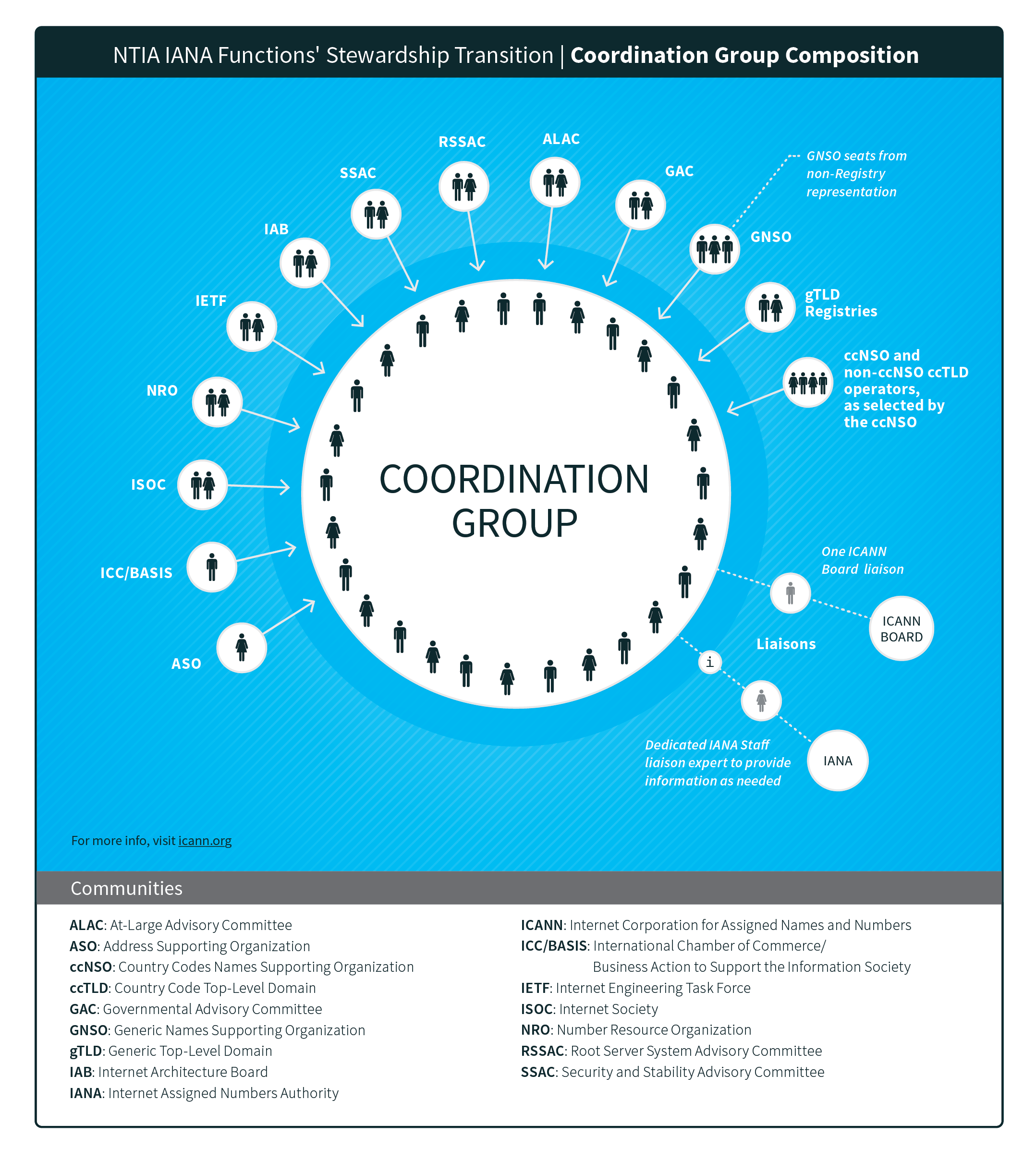 |
| NTIA IANA functions transition Coordination Group Composition (click to enlarge) |
ICANN has published a Process to Develop the Proposal and Next Steps that is "the culmination of a series of community discussions and input into the process to develop a proposal to transition the IANA functions to the global multistakeholder community," see ICANN's NTIA IANA Functions' Stewardship transition for more information. According to ICANN: "the document reflects the multitude of views expressed in different fora and establishes the creation of a Coordination Group [formerly the proposed "Steering Group"--see graphic above] and its composition" and calls on the respective community members represented in the Coordinating Group to launch their internal processes to select their representative members no later than July 2, 2014 -- see further below for selected excerpts from the ICANN document:
To ensure full transparency, the (IANA Transition) Coordination Group will hold open meetings accessible to all global stakeholders; relevant transcripts and recordings will be posted on the website.
The Coordination Group will be responsible for preparing a transition proposal respective of the differing needs of the various affected parties of the IANA functions. It should be responsible for assembling the components from the respective communities into a single proposal meeting the criteria set out by NTIA. Namely, it must have broad community support and address the following four principles:
Once a proposal is developed, ICANN will review the proposal to ensure it is in compliance with the defined framework and criteria and determine: 1) adherence to the NTIA principles and 2) conformity with the principles outlined by the community input. The responsibility for consideration and acceptance (as appropriate) of the proposal is solely vested in NTIA. ICANN's assessment of whether or not the process met the above mentioned requirements will be communicated with the proposal. (source ICANN)
The Coordination Group will be responsible for preparing a transition proposal respective of the differing needs of the various affected parties of the IANA functions. It should be responsible for assembling the components from the respective communities into a single proposal meeting the criteria set out by NTIA. Namely, it must have broad community support and address the following four principles:
- Support and enhance the multistakeholder model;
- Maintain the security, stability, and resiliency of the Internet DNS;
- Meet the needs and expectation of the global customers and partners of the IANA services; and,
- Maintain the openness of the Internet.
Once a proposal is developed, ICANN will review the proposal to ensure it is in compliance with the defined framework and criteria and determine: 1) adherence to the NTIA principles and 2) conformity with the principles outlined by the community input. The responsibility for consideration and acceptance (as appropriate) of the proposal is solely vested in NTIA. ICANN's assessment of whether or not the process met the above mentioned requirements will be communicated with the proposal. (source ICANN)
23 May 2014
ICANN Accountability, IANA Transition, Karl Auerbach Letter
By now, most people in the domain name industry are aware of the NTIA announcement and the ongoing process convened by ICANN in regard to IANA functions, as well as ICANN's own process for enhancing its own accountability. The most important document published thus far in regard to either ICANN accountability or IANA transition is a letter written by Karl Auerbach to the US Congress that covers both issues. Karl is a former member of the ICANN Board of Directors, an internet technologist who has written internet standards that have been adopted by the IETF, has been a principal in several internet start-ups, is a recipient of the Norbert Wiener Award for Social and Professional Responsibility, and has been named a fellow of law and technology at Cal Tech and Loyola Marymount. He is also a member of the California Bar and its Intellectual Property section.
Those interested in either ICANN or IANA should read his entire letter (it is a "must read") which can be found here.
Excerpts from Karl Auerbach's letter (emphasis added):
"IANA is essentially a clerical job that usually involves no significant amount of discretion. (And in those rare cases where technical discretion is needed the various technical standards organizations, such as the Internet Engineering Task Force – the IETF – provide specific guidance and designate experts to be consulted.) There is no particular reason why ICANN and IANA are bundled into the same organization. IANA could be handled by any competent clerical provider – such as an established accounting firm. Rather than being a parent organization to IANA, ICANN could just as well be a client for IANA services. Because ICANN is essentially a body that regulates economic and business matters – and is thus subject to storms of debate from financially interested groups – it would be better for IANA to be held separate from ICANN and allowed to do its clerical job in peace and avoid being dragged into matters in which it has no interest and no role."
"ICANN does vanishingly little with regard to the technical stability of the internet and, instead, uses its de facto monopoly position to do a land office business selling rights to internet territory. ICANN does not “assure the technical stability of the internet”. Rather, ICANN dispenses commercial rights and privileges. In exchange for its largess ICANN obtains monopoly rents, significantly restricts legitimate and innovative business practices, and imposes expansive trademark protection well beyond what is required by any law of any nation. ICANN is a private regulatory body that promotes its particular view of social engineering, internet business practices, trademark protection, and preservation of incumbent interests."
more news links below (on mobile go to web version link below)
Follow @expvccom
Excerpts from Karl Auerbach's letter (emphasis added):
"IANA is essentially a clerical job that usually involves no significant amount of discretion. (And in those rare cases where technical discretion is needed the various technical standards organizations, such as the Internet Engineering Task Force – the IETF – provide specific guidance and designate experts to be consulted.) There is no particular reason why ICANN and IANA are bundled into the same organization. IANA could be handled by any competent clerical provider – such as an established accounting firm. Rather than being a parent organization to IANA, ICANN could just as well be a client for IANA services. Because ICANN is essentially a body that regulates economic and business matters – and is thus subject to storms of debate from financially interested groups – it would be better for IANA to be held separate from ICANN and allowed to do its clerical job in peace and avoid being dragged into matters in which it has no interest and no role."
"ICANN does vanishingly little with regard to the technical stability of the internet and, instead, uses its de facto monopoly position to do a land office business selling rights to internet territory. ICANN does not “assure the technical stability of the internet”. Rather, ICANN dispenses commercial rights and privileges. In exchange for its largess ICANN obtains monopoly rents, significantly restricts legitimate and innovative business practices, and imposes expansive trademark protection well beyond what is required by any law of any nation. ICANN is a private regulatory body that promotes its particular view of social engineering, internet business practices, trademark protection, and preservation of incumbent interests."
"NTIA's role in ICANN has largely been to shield ICANN from questions, most particularly questions that would normally arise about a private body that restrains trade and innovation. One must ask whether that behavior constitutes oversight at all. Or has an absence of oversight by NTIA allowed ICANN to become a permissive playground for financially interested entities to promote private agendas?"
more news links below (on mobile go to web version link below)
Follow @expvccom
20 May 2014
IANA functions transition, Commerce Counsel's Letter to Congress
Kelly R. Welsh, the General Counsel of the US Department of Commerce, wrote a letter to Congress on May 6, 2014, documenting the Department's position about the NTIA authority to transition the stewardship role regarding the IANA Functions. Full letter here (pdf)

05 May 2014
Mueller: ccNSO smashed the tricks of ICANN and NTIA
wonderful that the ccNSO saw through all ICANN's & NTIA's tricks and smashed them so adroitly http://t.co/HWXczZEXzd
— Milton Mueller (@miltonmueller) May 4, 2014
ccNSO interim comments are here (pdf), excerpt:
".... it is the view of the ccNSO Council that any transition of responsibility for the IANA Functions must establish the processes and procedures through which operational requirements for the root zone management functions will be developed, processes and procedures through which the IANA functions operator will be chosen, as well as processes and procedures by which the IANA functions operator will be accountable to the stakeholder community with respect to such requirements. ... ICANN has consistently failed to acknowledge that TLD registries – both country code TLDs and generic TLDs – are as much “affected parties” as are the IETF, the IAB, ISOC, and NRO....Accordingly, we call on ICANN to expand the proposed steering group to include two representatives selected by the ccTLD community and two representatives selected by the Registry Stakeholder Group as “affected parties...Because ICANN is directly interested in the outcome of the multi-stakeholder process being launched, SO and AC participants on the steering committee should be selected by the communities they represent, not by the chairs of the ICANN Board and GAC. The approach proposed in the ICANN Draft is “top-down” and also has the appearance of being self-serving...this process must take into account and provide a replacement for the role that NTIA has played in overseeing ICANN’s obligation to develop and implement consensus policies through a bottom up multistakeholder process, and to be accountable to all stakeholders for the outcome of its decision-making. The ccNSO was not alone in expressing concern about ICANN’s apparent insistence on separating these issues. To the extent that ICANN continues to insist on maintaining separate tracks to address each of these issues, it must ensure that the two tracks come together in advance of the transition itself. Moreover, ICANN should not prejudge or attempt to manipulate the outcome by conflating the issues of globalization and accountability, nor should it assume an “affirmation of commitments” approach to accountability. We understand that in the near future ICANN will issue a draft proposal to address broader accountability issues, and we look forward to reviewing and commenting on that document as well. (emphasis added)
In other words, ccNSO is telling ICANN (and NTIA), stop the BS, we will not allow you to hijack the IANA transition process in your typical top-down manner, and ICANN accountability needs to be addressed by the multi-stakeholder community.
more news links below (on mobile go to web version link below)
Follow @expvccom
09 April 2014
Letter from US Senators to NTIA's Strickling about IANA Transition
On April 2, 2014, U.S. Senators John Thune (R-S.D.) and Marco Rubio (R-Fla.) and 33 of their Senate Republican colleagues sent a letter to Assistant Secretary of Commerce Larry Strickling, head of the National Telecommunications and Information Administration (NTIA), seeking clarification regarding the recent announcement that NTIA intends to relinquish responsibility of the Internet Assigned Numbers Authority (IANA) functions to the global multistakeholder community. The full letter can be found here, excerpt below --
" . . . .Because this issue is so important to the future of the Internet and for the protection of American values and interests, we request expeditious responses to the following questions and requests for information about the proposed IANA transition.
more news links below (on mobile go to web version link below)
Follow @expvccom
" . . . .Because this issue is so important to the future of the Internet and for the protection of American values and interests, we request expeditious responses to the following questions and requests for information about the proposed IANA transition.
- A 2000 report by the U.S. General Accounting Office stated that “it is unclear if the Department [of Commerce] has the requisite authority” to transfer control of the IANA functions to a private entity. Please provide us with the Administration’s legal views and analysis on whether the United States Government can transition the IANA functions to another entity without an Act of Congress.
- Please explain why it is in our national interest to transition the IANA functions to the “global multistakeholder community.”
- You have stated that NTIA believes “the timing is right to start the transition process.” Why does the Administration believe now is the appropriate time to begin the transition, and what was the specific circumstance or development that led the Administration to decide to begin the transition now?
- What steps will NTIA take to ensure the process to develop a transition plan for the IANA functions is open and transparent?
- Will NTIA actively participate in the global multistakeholder process to develop a transition plan for the IANA functions, or will the Administration leave the process entirely in the hands of ICANN?
- You have stated that NTIA “will not accept a proposal that replaces NTIA’s role with a government-led or an inter-governmental solution,” but NTIA has been silent on how it will ensure the IANA functions do not end up being controlled, directly or indirectly, by a government or inter-governmental entity. What specific options are available to NTIA to prevent this from happening?
- How can the Administration guarantee the multistakeholder organization that succeeds NTIA will not subsequently transfer the IANA functions to a government or intergovernmental organization in the future, or that such successor organization will not eventually fall under the undue influence of other governments?
- NTIA asked ICANN to lead the transition process. However, ICANN has a potential self-interest in increasing its own autonomy and reducing its accountability to other entities. Some stakeholders have expressed concerns that ICANN may seek to control the IANA functions on its own, without oversight from anyone else. How did NTIA determine that ICANN is the appropriate entity to lead the transition process, and how will NTIA ensure that ICANN does not inappropriately control or influence the process for its own self-interest?
- Does NTIA believe ICANN currently is sufficiently transparent and accountable in its activities, or should ICANN adopt additional transparency and accountability requirements as part of the IANA transition?
- Is it realistic to expect that an acceptable transition plan can be developed before the IANA functions contract expires on September 30, 2015? Is there another example of a similar global stakeholder transition plan being developed and approved in just 18 months?
- How will NTIA ultimately decide whether a proposed transition plan for IANA, developed by global stakeholders, is acceptable? What factors will NTIA use to determine if such a proposal supports and enhances the multistakeholder model; maintains the security, stability, and resiliency of the Internet Domain Name System; meets the needs and expectation of the global customers and partners of the IANA services; and maintains the openness of the Internet?
- Will NTIA also take into account American values and interests in evaluating a proposed transition plan? How?
more news links below (on mobile go to web version link below)
Follow @expvccom
Subscribe to:
Posts (Atom)


